
Frequently Asked Questions
Find answers to common questions about wind energy
What is Apex Clean Energy?
Apex Clean Energy is an American clean energy company based in Charlottesville, Virginia. Our mission is to accelerate the shift to clean energy. We work with communities across the country to develop, construct, own, and operate wind, solar, and energy storage projects.
Our team of nearly 400 professionals has commercialized over 50 projects representing over 10 gigawatts (GW) of energy capacity, enough to power more than 4 million American homes annually. Our partners have included major utilities, businesses with significant energy needs, and even the U.S. Army and Department of Defense.
How does wind power work?
Wind power captures the natural wind in our atmosphere and converts it into mechanical energy, then electricity. This is not exactly new technology; humans have been harvesting the wind for centuries, starting with windmills that pump water, process grain, and generate power.
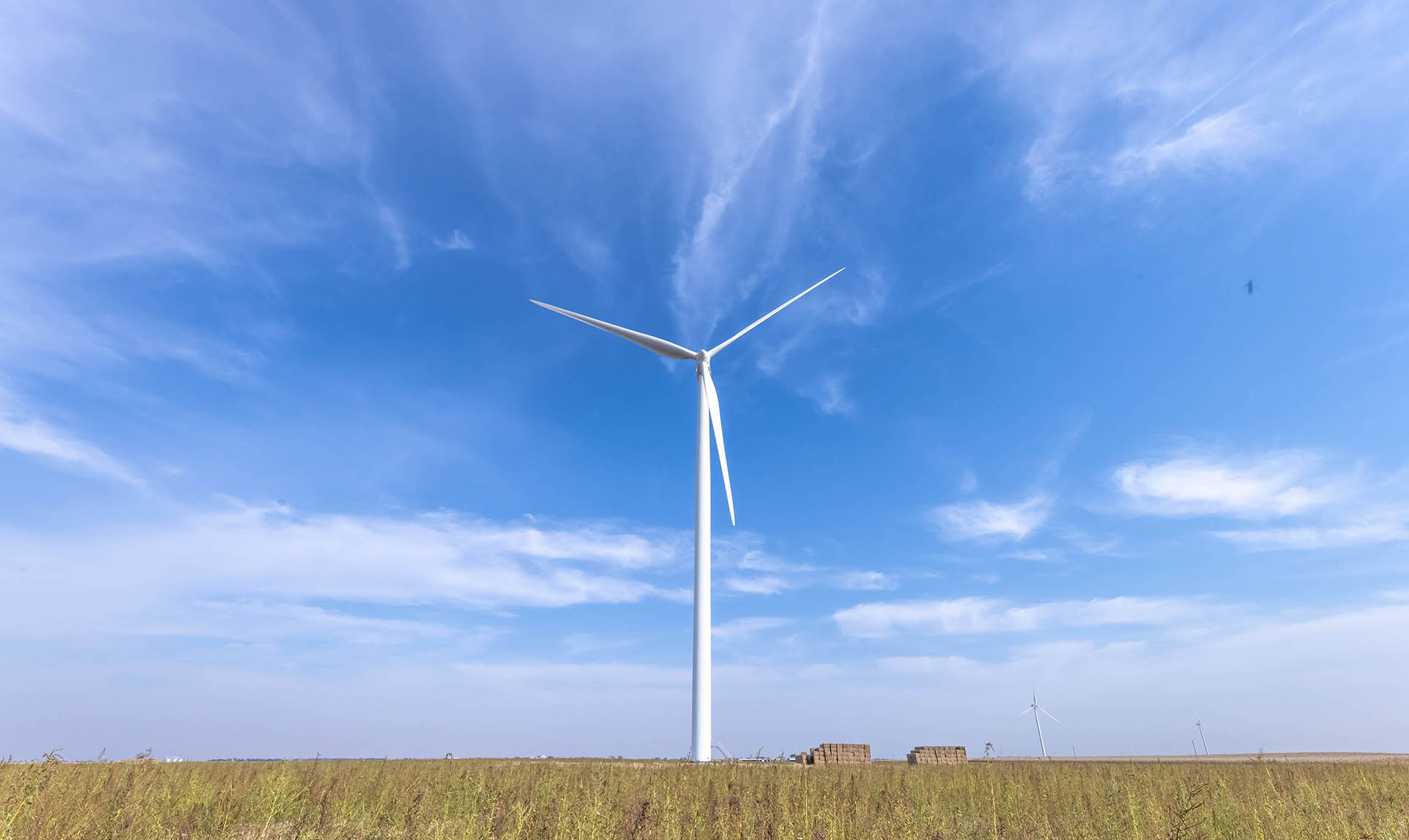
Today's wind turbine is a highly evolved version of a windmill. Modern wind turbines harness wind's kinetic energy and convert it into electricity. Most wind turbines have three blades and sit atop a steel tubular tower, and they range from 80-foot-tall models that can power a single home to utility-scale models that are over 500 feet tall and power thousands of homes.
Why Solar?
Over the past few years, demand for new energy generation has grown dramatically. Because solar energy is clean, reliable, and among the most affordable sources of new power generation, it has earned the spot as the fastest-growing source of electricity in the world.
Solar energy also provides a new source of income for local farmers and landowners looking to diversify their operations, generates new tax revenue for area school districts and local governments, and creates hundreds of good-paying jobs during construction as well as several long-term local careers during operations.
How do solar panels work
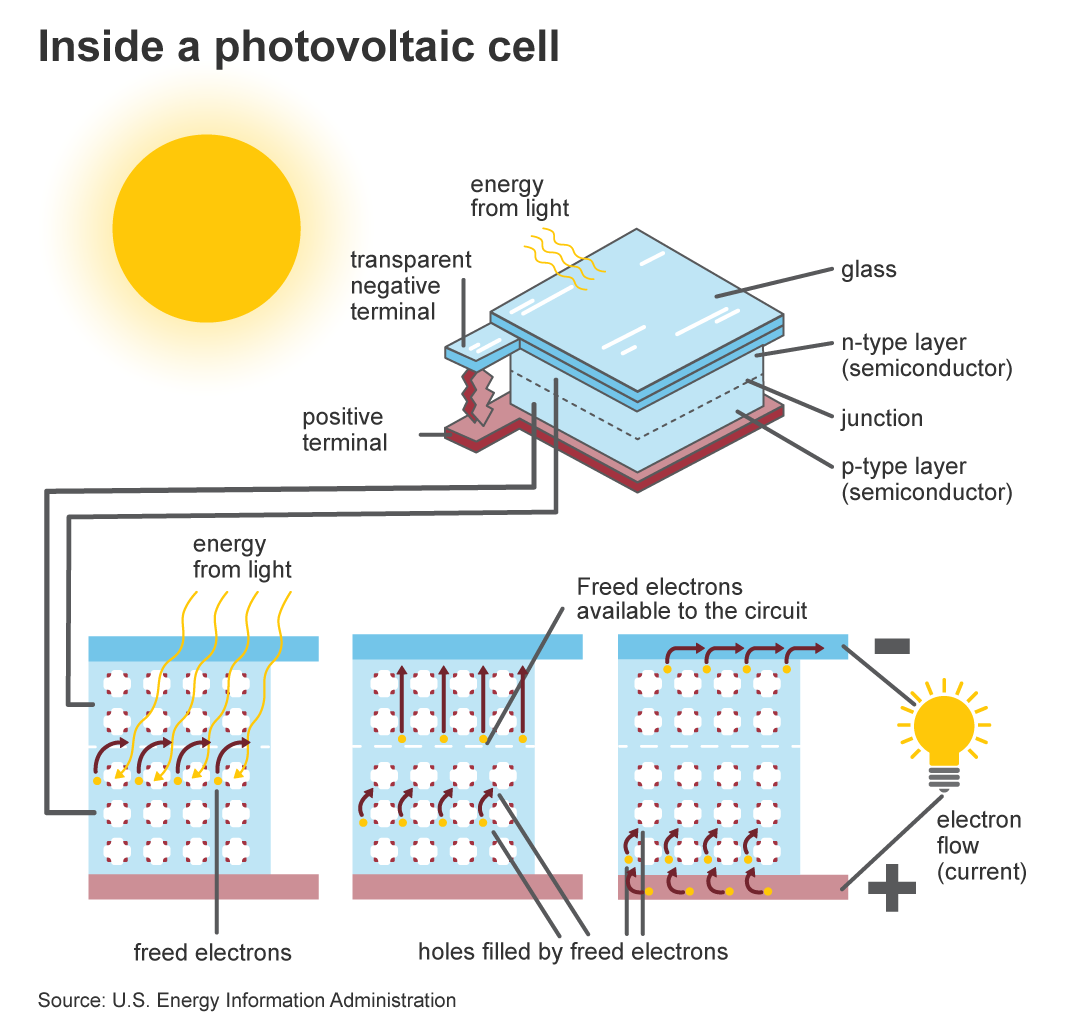
Solar panels convert sunlight into electricity through a process called the photovoltaic effect, where sunlight strikes semiconductor materials like silicon within the panel, causing electrons to become energized and flow, creating an electric current that can be harnessed to power devices; this direct current (DC) is then converted to alternating current (AC) by an inverter for household use.
What happens on cloudy days?
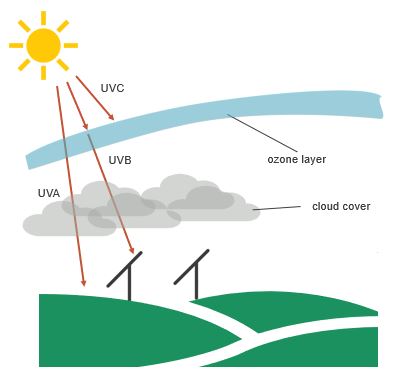
Did you know that solar panels still produce between 10% and 25% of their typical output even on a cloudy day? The falling costs of solar panels help make solar cost-effective even in cloudy regions. Advanced tracking systems also enable solar panels to follow the sun throughout the day and maximize the amount of electricity generated.
Do solar panels work in the winter? What about when they are covered with snow?
You might be surprised to learn that sunny cold weather is actually an ideal condition for solar panels to perform optimally. On the other hand, extremely hot climates actually make solar panels less efficient.
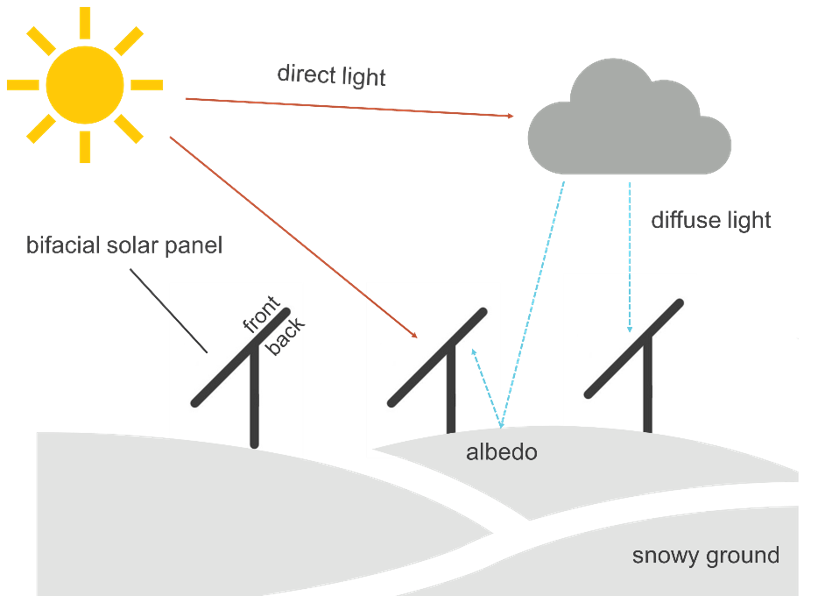
As far as snow is concerned, a light dusting of snow has little impact on the panels and can be easily blown off by wind. Because panels are tilted at an angle, snow will also slide off of panels over time, cleaning the panel as it melts and slides off.
Interestingly enough, because of the reflectivity, or albedo effect, of snow, having snow on the ground near the panels can contribute towards them producing more electricity, with the smooth white surface reflecting light like a mirror. There are also bifacial modules that can allow a panel to generate electricity from both sides to take advantage of this reflected solar radiation.
How much land is needed for a solar project?
As a general rule, utility-scale solar energy facilities require between four and eight acres of land per megawatt of energy capacity. More than half of this area is open space between the panels to prevent shading and is usually planted with native or noninvasive grasses.
In recent years, solar panels have become much more efficient, requiring less land to generate the same amount of power. A 2022 study by Lawrence Berkeley National Laboratory found that the median generating capacity per acre for solar farms increased by more than 40% between 2011 and 2019. To put it another way, a median 100-megawatt tracking solar array would have needed 600 acres in 2011 but only needed 420 acres in 2019.
What does a solar farm look like?
Solar arrays spend most of the day at a low angle and at their maximum tilt (sunrise/sunset) generally reach no more than 12ft tall for single-panel arrays or 20 feet tall for double-panel arrays. Apex Clean Energy generally utilizes single panel arrays with a maximum height of no more than 12ft tall at full tilt.
The entire project will be surrounded by a fence, as required by the Federal Energy Regulation Commission (FERC). Apex has used both chain-link galvanized steel fencing that is six feet high, with an additional foot of security wire, or seven foot high wire mesh wildlife permeable fencing, depending on site-specific factors and local requirements.
Because panels are often screened by trees and other plantings outside project fencing, the visibility of a solar farm to nearby residences is minimal. As development progresses and the project is designed, we will identify areas where the project may be visible and where additional setbacks or vegetative screening may be appropriate to minimize visibility.

Why Here?
Wind energy is generated across the United States, with 44 states hosting wind projects as of 2026. To develop a viable wind project, there are many factors to consider, but the following attributes are among the most important:
• Verified wind resource (based on National Renewable Energy Laboratory data and measured with meteorological evaluation towers during project development)
• Expansive private land with interested farmers and landowners
• Nearby high-voltage transmission lines with available capacity, limiting the need for new infrastructure
• Proximity to state highways and transportation infrastructure
• Avoids sensitive airspace and environmental areas
• Demand from local utilities or businesses for renewable energy
• Access to local skilled workforce
Will solar raise my electric bill?
Quite the opposite, the cost of solar power has dropped by more than 85% since 2010 and among the cheapest sources of electricity in many places across the United States.
Utility-scale renewable energy prices are now significantly below those for coal and gas generation, and they are less than half the cost of nuclear. Building new utility-scale solar energy generation is even cheaper than continuing to operate existing coal plants. By adding more solar energy to their systems, utilities can help make sure that the consumer costs of energy remain stable, since they are not affected by fluctuating fuel prices.
Solar power also has the benefit of producing electricity during the times of day when demand and power costs are the highest. On a midsummer afternoon, for example, when homes and businesses are running their air conditioners at full power, a solar facility is generating at full power as well, which helps close the gap between electricity supply and electricity demand. This has the effect of lowering electricity costs across the board.
Recent studies show that solar and wind energy reduce the average wholesale price of electricity in all electricity markets. When paired with energy storage, solar projects can be an affordable alternative to natural gas peaker plants, which are designed to run only about 15% of the time, if not less, during periods of peak power demand.
What is the overall footprint of a wind project?
The size of a project is dependent on local transmission line capacity. A typical 300 megawatt (MW) project would generate enough homegrown clean energy to power over 90,000 homes annually.
Each wind turbine will take up less than an acre of land on average, including its associated access road.
Although wind projects may lease thousands of acres, wind turbines and access roads usually cover less than 1% of land leased.
Where will the wind turbines be placed? When will the public be able to see a draft turbine layout?
Later in the development process, a proposed turbine layout will be assembled for permitting. The final project layout will be dependent on the total number of project participants, setbacks required by local ordinances, wetland and environmental studies, and consultations with the FAA.
Any layout is also subject to multiple revisions. Layouts are generally solidified in the very late stages of project development, and they are first shared with the participating landowners to identify and address any issues they may have with the project plan for their particular properties. A detailed final site plan will be submitted to the appropriate local and/or state authority when the project files for its permit.
To learn more about how wind farms are designed and the various setbacks that are applied, visit siting.apexcleanenergy.com
How do I know if my land qualifies to be in the project?
We continually evaluate prospective project areas to determine whether there are enough interested landowners to develop and build a project. If you live inside our area of interest, your property may qualify to participate in the project through our community-based leasing model, either as a landowner or as a neighbor.
If you are interested in participating in the project, contact us here.
If you are interested in hosting a project in a different community, visit the form on the landowner resources page at apexcleanenergy.com/landowners.
Who benefits from the project? Just large landowners?
Apex typically uses a community-based lease for our projects that spreads some of the financial benefits from the project more broadly among participating landowners and residents.
Under this model, anyone living in the project area is eligible to sign up and see direct monetary benefit from the project, whether you own a single acre and a home, 1,000 acres of farmland, or anything in between. Landowners and community members participating in the project will receive annual lease payments over the projected 30-plus-year lifespan of the project, injecting millions of dollars into the local economy to support family budgets and local businesses.
Will Apex sell the project once it is built?
Apex develops, constructs, owns, and operates projects across the country. We have constructed over 30 projects and currently operate more than a dozen wind, solar, and energy storage facilities using local operations and maintenance staff, as well as support from our 24/7 Remote Operations Control Center in Charlottesville, Virginia.
Although Apex prefers to own and operate all of our projects, a local electric utility may occasionally be interested in purchasing a project after the completion of construction and operate the facility alongside its other generation sources in the state. A utility could also purchase the power from Apex while we continue to own and operate the facility.
The sale of a project to another entity is not a cause for concern. Every agreement and contract signed by the project prior to any potential transfer of ownership will remain in place if a transfer occurs. Commitments made to landowners and local governments will not change and are fully enforceable under the law.
What is the project timeline?
A typical wind project will take several years to develop and permit before construction and operations begin. The development process includes land leasing, a variety of engineering and environmental studies, and community outreach, often spanning 2–3 years. Once leasing is complete, the project undergoes a state or local permitting process before construction, which typically lasts 12–18 months, depending on project size and weather conditions.
Once construction is complete, wind projects are designed to last a minimum of 25–30 years, generating significant benefits for the landowner and the community for decades.
Can anything be placed on my property without my permission?
No. Project components will only be sited on private properties that have landowner agreements with Apex. All agreements are fully voluntary between individual landowners and the project.
Where will the power from the project go?
The power from the project will connect to a local electrical grid via a nearby transmission line with available capacity, usually operated by a regional transmission organization (RTO) such as MISO (the Midcontinent Independent System Operator) in the Midwest. RTOs help connect energy from multiple generation sources to ensure a stable and reliable grid. When you turn on your lights at home, you are pulling power from this robust system.
Electricity from projects will mix with electricity from all other generators on the grid. The power generated by the project will be both used locally and sent where it is needed depending on local and regional generation and electricity demand.
Is this project subsidized by taxpayers?
Apex projects are entirely privately funded. No federal cash subsidies or ratepayer dollars will be used to build the project and, once built, the project will provide a long-term, competitive source of electricity for the regional electric grid.
Historically, all forms of energy have been incentivized in some fashion. Between 1950 and 2016, 65% of all energy subsidies went to conventional fuel sources.
Today, wind and solar projects are eligible for either the investment tax credit (ITC) or the production tax credit (PTC). Unlike a grant or direct subsidy, these tax credits reduce income tax obligations for wind or solar project owners based on the amount of energy produced or the overall capital cost of the project. These savings allow a project to charge lower rates for its energy. Thus, like all other energy incentives, they help save money for consumers. These incentives are being phased out for wind and solar projects starting construction after 2027, but even without the incentive, wind and solar energy remain price competitive. The PTC remains available to many other sources of energy, including nuclear, geothermal, and hydroelectric power through 2033.
In recent years new incentives have been offered to the coal industry, which has generally lost ground to cheaper sources of energy like natural gas and renewables. These subsidies include new federal tax credits for coal production, reduced royalty rates for coal extracted from public lands, and direct subsidies to coal companies via federal grants.
Will this project raise my electric bill?
Quite the opposite. Wind energy is the cheapest form of new generation in most parts of the country. The cost of wind energy has dropped by 65% since 2009 (Source: Lazard, “Levelized Cost of Energy Analysis,” Version 17.0, June 2024).
For a wind project to succeed, there has to be a buyer for its power. Generally, this electricity is purchased by utilities, manufacturers, universities, or municipalities that demand large amounts of energy. These large-scale customers buy wind power because:
• Wind energy is a cost-competitive energy source. The input costs for wind remain stable because the fuel for wind energy is free.
• Once a project is built, the cost of producing energy remains constant, so power purchase contracts “lock in” a predictable, steady electricity rate for 15 to 20 years.
• Wind energy is clean, reducing pollution and its associated health impacts while helping meet local renewable energy goals.
Will this project raise my electric bill?
Quite the opposite. Wind energy is the cheapest form of new generation in most parts of the country. The cost of wind energy has dropped by 65% since 2009 (Source: Lazard, “Levelized Cost of Energy Analysis,” Version 17.0, June 2024).
For a wind project to succeed, there has to be a buyer for its power. Generally, this electricity is purchased by utilities, manufacturers, universities, or municipalities that demand large amounts of energy. These large-scale customers buy wind power because:
• Wind energy is a cost-competitive energy source. The input costs for wind remain stable because the fuel for wind energy is free.
• Once a project is built, the cost of producing energy remains constant, so power purchase contracts “lock in” a predictable, steady electricity rate for 15 to 20 years.
• Wind energy is clean, reducing pollution and its associated health impacts while helping meet local renewable energy goals.
What economic impacts do wind projects have?
Wind projects are often one of the largest economic development projects in recent years for communities that host them. Wind projects result in hundreds of millions of dollars in construction spending, tens of millions of dollars in payments to landowners and community participants, and tens of millions of dollars in taxes over the lifetime of the project.
As an example, the Apex-built Isabella Wind project in Michigan paid nearly $25 million in local property taxes during its first four years of operation (2021–2024). These funds have supported the local school district, township governments, and county services like road repair and public safety.
Where are wind turbines manufactured?
Wind turbines and their components (tower sections, nacelles, and blades) are constructed all over the world. The United States hosts a robust wind energy manufacturing sector, including GE, one of the world’s largest wind turbine producers. Another manufacturer, Denmark-based Vestas, has manufacturing facilities in Colorado specializing in blades and nacelles.
For a recent Apex-constructed project in Iowa, the turbine blades were built in El Paso, Texas; the steel towers came from facilities in Iowa, South Dakota, and Oklahoma; and the nacelle came from GE’s manufacturing facility in Pensacola, Florida. Apex’s Isabella Wind project used steel tower sections made by Ventower, a company located in Monroe, Michigan.
According to the Department of Energy, over 85% of nacelle assembly and 70% to 85% of tower manufacturing took place in the United States for wind projects installed in 2022 (Source: Land-Based Wind Market Report: 2023 Edition).
Do wind farms negatively affect residential property values?
The latest and most robust studies show that wind farms do not have long-term negative impacts on residential property values. On the other hand, it is well documented that wind farms drive community economic development and provide funding for local schools and services, which benefit all property owners in a hosting community.
In 2023, Lawrence Berkeley National Laboratory released a study that examined approximately 500,000 home transactions across 34 states and 428 different wind projects between 2005 and 2020, including data from both the preconstruction and operations phases. This new, large-scale study found no impacts from wind farms on home values in rural counties (with a population under 250,000), which host 94% of all installed wind capacity.
A 2024 study published in the peer-reviewed Proceedings of the National Academy of Sciences focused on the visibility of wind turbines from homes. This study found no effect on property values for modern wind turbines installed since 2017.
What happens to the wind turbines at the end of their lifetime? Are landowners or local governments responsible for taking them down?
When a turbine reaches the end of its useful life, it can be decommissioned (removed) or retrofitted (“repowered”).
Typically, local ordinances require wind projects to submit plans for decommissioning the facility at the project owner’s expense. A decommissioning bond is often posted in favor of the county or local jurisdiction and assessed based on the presumed per-turbine cost of removal. Removal is then the responsibility of the project owner, whether that is the original developer, a utility, or another company that may own and operate the project in the future. If something happens to the project owner’s finances in the future, that decommissioning bond is already in place to provide the resources to remove the turbines once they are no longer in use.
If the need to remove a turbine or wind farm does arise, every landowner who signs an agreement with Apex is protected from the cost and burden of decommissioning through a protected financial security outlined and required in the easement agreement. Upon decommissioning, the site must also be restored to the same condition it was in prior to construction.
How does the height of a wind turbine affect its energy production?
Wind energy has evolved and improved over time. As wind turbines have increased in size, they have become more efficient, quieter, and able to produce more power per turbine. The power output of a turbine has a direct relation to its rotor diameter – the swept area of the blades.
A 20% increase in permitted tip height can increase annual electricity production by up to 90%, reducing the number of turbines needed for a given project. to reach its target capacity.
How much energy can a wind turbine produce?
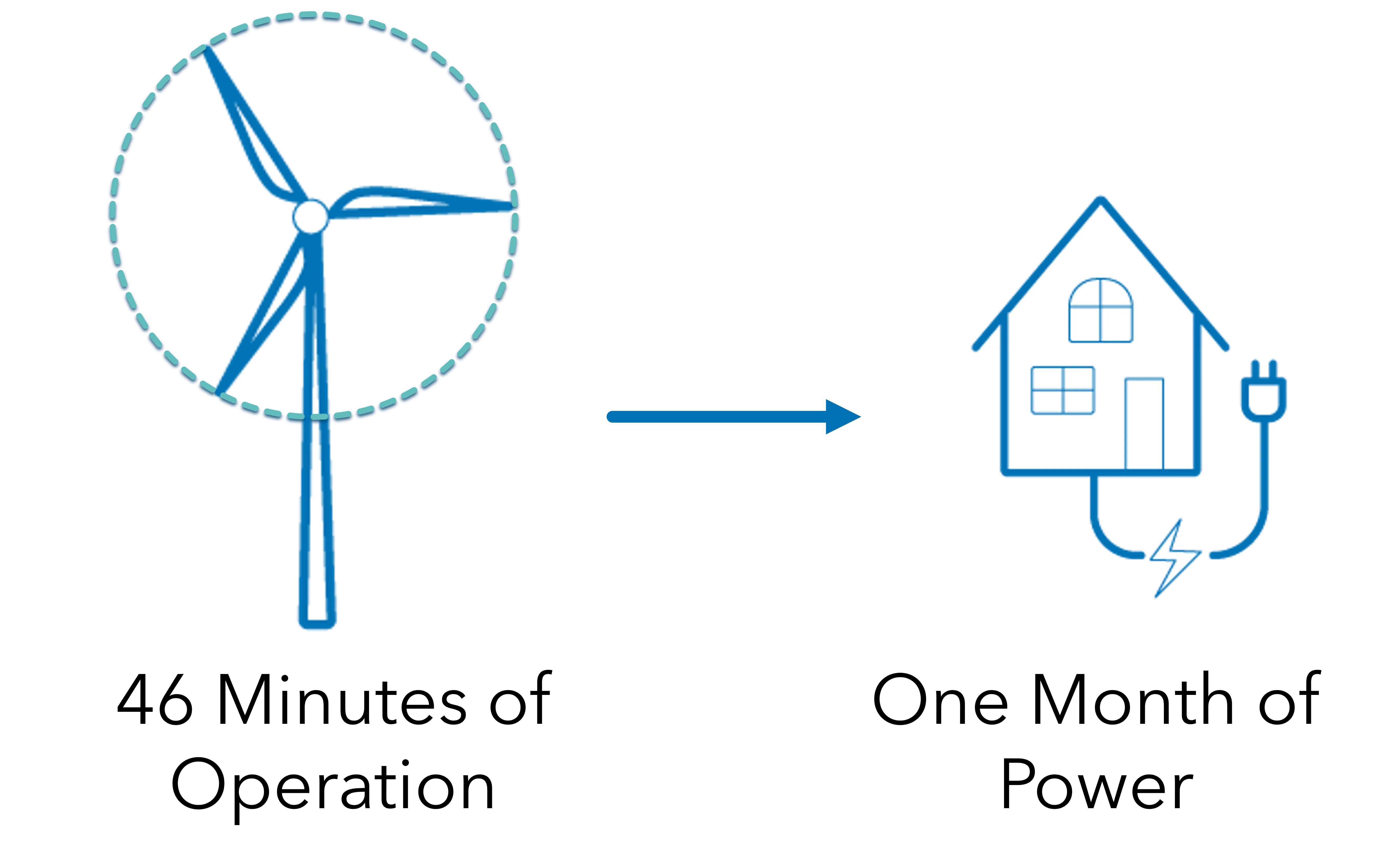
The average wind turbine that came online in 2020 generates enough electricity in just 46 minutes to power an average U.S. home for one month.
Put another way, a single rotation of the blades on a typical (4.2 MW) wind turbine generates enough electricity to power an average America home for around 4 hours.
How long does it take a wind turbine to generate more energy than was used to manufacture it?
A typical wind project generates enough energy to “pay back“ the energy that went into its manufacturing, transportation, and installation within 5-8 months. Over the life cycle of a 4.2 MW wind turbine, it will return 50 times more energy back to society than it consumed.
Are wind turbines required to have blinking red lights?
The Federal Aviation Administration (FAA) requires wind turbines to be equipped with red aviation obstruction lighting that can blink on and off to alert incoming aircraft of the presence of an obstruction.
There are options to significantly reduce this lighting through use of an Aircraft Detection Lighting System (ADLS), a sensor-based system that uses radar to detect aircraft as they approach the project (within 3.5 miles of the project boundary and 1,000 feet above the turbines tip heigh). These sensors automatically activate the appropriate obstruction lights until they are no longer needed by the aircraft. This technology reduces the impact of nighttime lighting on nearby communities by preventing lights from turning on unless an aircraft is approaching the facility.
ADLS technology reduces the amount of time that turbines are lit by 96% to 98% compared to traditional FAA lighting. Although ADLS technology has been approved by the FAA, each individual project must still be reviewed and approved by the agency. An ADLS plan may be modified or denied by the FAA based on proximity to airports, low-altitude flight routes, military training areas, or other areas of frequent flight activity.
Will the wind farm be harmful to local wildlife and the environment?
Wind energy is one of the most environmentally friendly forms of electrical generation on the planet. That is because wind energy emits no air or water pollution, requires no mining or drilling for fuels, uses virtually no water, and creates no hazardous or radioactive waste. Clean, renewable wind energy also displaces harmful emissions from fossil fuel plants and offsets carbon emissions, making it a safer generation option for people, wildlife, and natural ecosystems.
Although birds unfortunately do occasionally collide with turbine blades, modern wind farms are far less harmful to birds than buildings, communications towers, power lines, and vehicles. In fact, turbines account for only a small fraction, about 0.0003%, of all human-related bird deaths. Housecats alone kill 2.4 billion birds a year.
(Source: stateofthebirds.org/2014%20SotB_FINAL_low-res.pdf)
Nonetheless, Apex works hard to minimize avian impacts through responsible siting. We will work in close consultation with federal and state environmental agencies and use targeted conservation measures to ensure that the project has no significant effects on bird or bat populations.
How will the wind farm impact local deer populations and hunting?
The operating wind farm will have no impact on the deer population or hunting. Just as deer adapt to construction of new homes, buildings, and other new sights and sounds near their habitats, the deer population also becomes accustomed to wind farms. It is not uncommon to find deer and other wildlife feeding or resting near the bases of turbines. Cattle, horses, goats, and other livestock are also 100% compatible with wind energy technology.
Will construction cause issues with stormwater or runoff?
Properly designed solar projects will maintain—and in some cases reduce and improve—existing agricultural runoff, thanks to permanent ground cover with deeper root systems that increase water retention and organic matter content in previously farmed soils.
Stormwater and runoff management is regulated at the federal, state, and local levels. Each state has different methods for regulating how construction projects are permitted with regards to stormwater, but most states require some form of permit to assess and mitigate potential runoff and/or erosion during construction.
These laws exist to ensure that no sediment or excess volume is allowed to flow into nearby waterways due to the new facility, and that no excess water is allowed to flow onto neighboring properties.
Construction of these projects does not begin until the required stormwater permits have been approved.
What does a wind farm sound like?
Modern turbine technology has been very effective in minimizing sound. Almost all modern turbines now employ quiet electric yaw motors, and new blade designs focus specifically on sound reduction.
As wind turbine blades pass through the air, they make a sound that is often described as a “whoosh.” Measurements of this sound show that it is no louder than a kitchen refrigerator or a standard air conditioning unit at a distance of 1,000 feet. Often the sound of a wind turbine on a windy day is indistinguishable from the sounds of the wind rustling through the trees and grass at this distance. (Source:https://www.nidcd.nih.gov/
All wind projects comply with Apex’s internal guidelines on sound as well as local wind ordinance requirements related to sound limitations at residences.
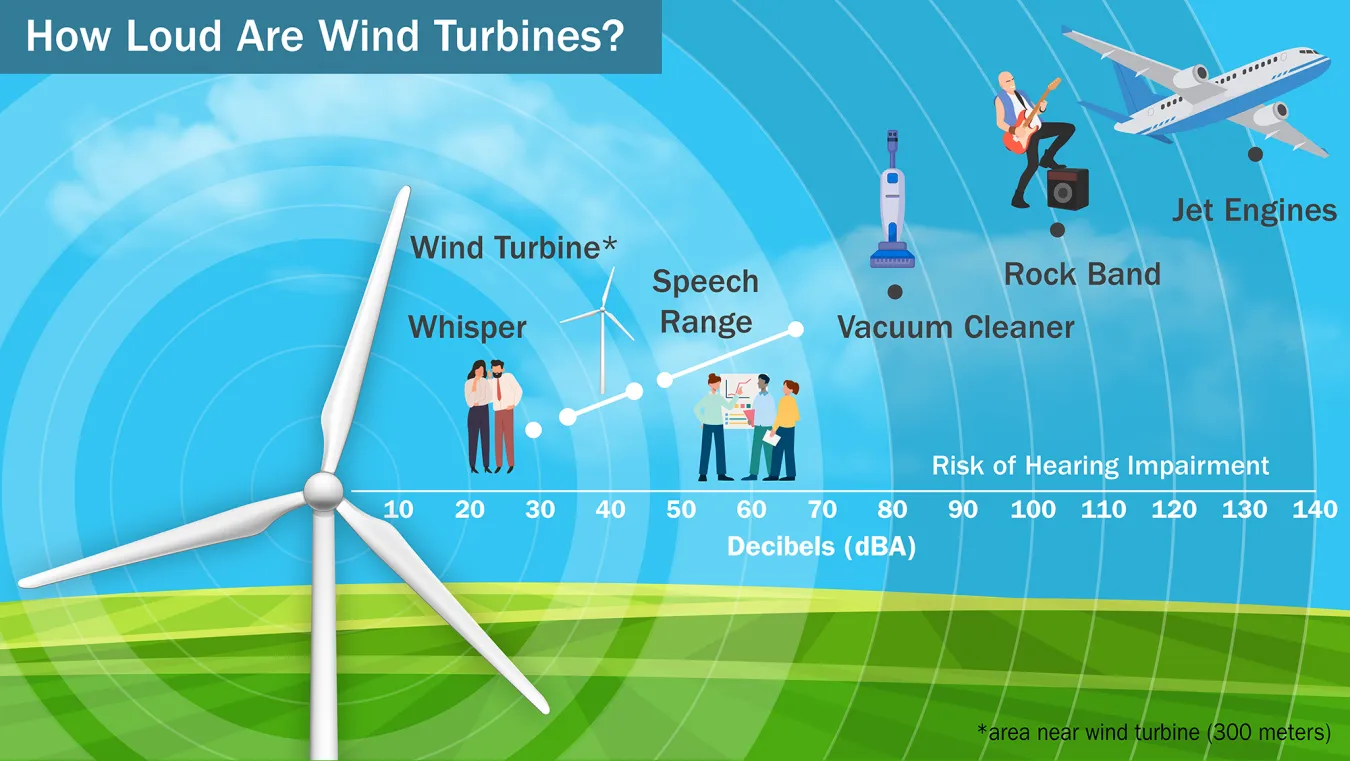
Learn more from the U.S. Department of Energy.
What is low-frequency sound? What about “infrasound”?
Most low-frequency sound and “infrasound” produced by turbines is significantly below the human hearing threshold. In reality, infrasound is generated by phenomena all around us. Natural examples include wind and waves. Man-made examples include cars, airplanes, appliances, and other large machines. Wind turbine infrasound levels are far lower than those experienced in everyday activities such as traveling in a vehicle, walking by the ocean, or standing outside in the wind.
Scientific evidence confirms that this sound is not dangerous and that any low-frequency waves produced are not harmful to those nearby. As reported in a recent study by the Massachusetts Department of Public Health: “… the weight of the evidence suggests no association between noise from wind turbines and measures of psychological distress or mental health problems.”
(Source:mass.gov/eea/docs/dep/energy/wind/turbine-impact-study.pdf
What is shadow flicker?
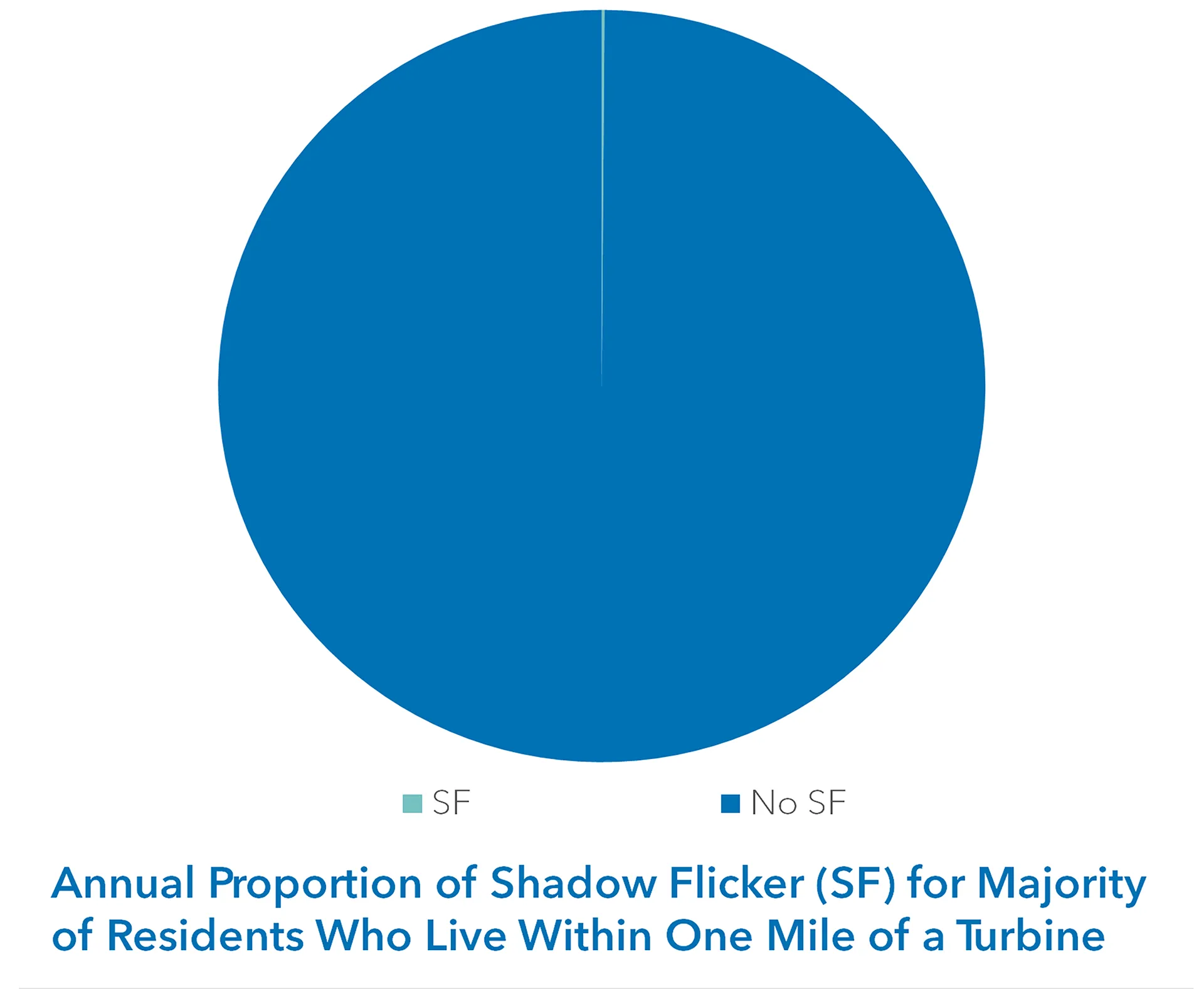
This term refers to the shadows cast by wind turbine blades as they rotate in front of the sun, similar to the shadow cast by a tree blowing in the wind.
By positioning wind turbines at a carefully calculated angle and distance from dwellings, Apex ensures that most homes in a project experience no shadowing at all. For those that do, shadowing will occur for no more than a few minutes per day, on average. Shadowing does not occur on cloudy or foggy days and a typical local wind ordinance might limit shadow flicker to no more than 1% of all daylight hours over an entire year (equivalent to 30 hours out of 8,760 hours of daylight per year).
Some worry that this flicker can cause seizures in photosensitive individuals; however, according to the Epilepsy Foundation’s research, the rate at which wind turbine shadows “flicker” is far below the frequency associated with seizures.
Is ice build-up a risk for wind turbines?
Wind turbines have been safely operating for three decades in locations where icing can occur. Ice buildup on a turbine is detectable through multiple technologies and cold-weather packages on modern turbines can even heat turbine blades and help prevent icing in the first place.
In the event that icing does occur and is detected by onboard sensors, turbines can be shut down during icing and thawing conditions to further minimize the risk and ensure ice melting off of turbines falls straight down.
In the unlikely event that the operational procedures designed to protect against icing are not completely effective, the average ice fragment shed from a turbine is quite small and the probability of an impact at Apex's standard setbacks is on the range of one in a million based on recommendations from the Finnish Meteorological Institute and virtually impossible beyond 2x the height of the turbine based on the Massachusetts Department of Health's Wind Turbine Health Impact Study.
How does wind energy affect water?
Wind energy helps preserve clean water. Replacing water-intensive fossil-fuel based power generation with electricity generated by wind can save more than 400 gallons of water per megawatt hour generated.
In contrast to some forms of energy that can pollute local water supplies, wind energy produces no hazardous waste that can pollute rivers or streams, and it uses nearly zero water during operation, making it an ideal energy source in a water-constrained world.
Where are solar panels manufactured?
The specific panel to be used will be selected later in the development process, closer to construction. Solar panels and solar project components are manufactured throughout the world, including right here in America.
In Leetsdale, Pennsylvania, BCI Steel manufactures racking and tracking systems like those that will be used for this project. One of America’s largest solar manel manufacturers, First Solar, is located in Toledo, OH, and Michigan’s Hemlock Semiconductor is American’s largest producer of hyper-pure polysilicon, used in solar panels and other electronics across the globe.
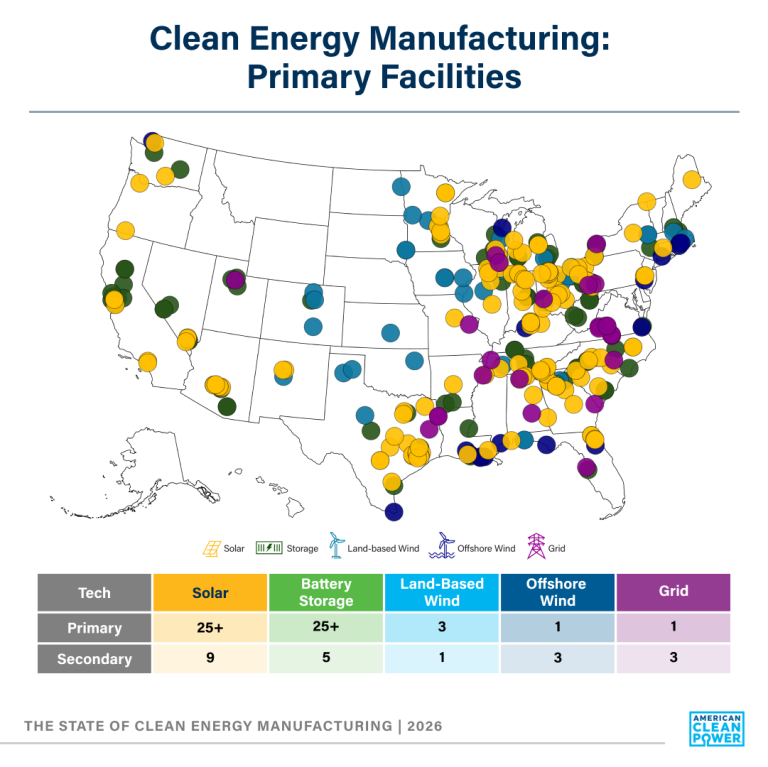
According to a recent report by the Advanced Power Alliance, clean power manufacturing supports 216,000 American jobs at over 800 facilities across all 50 states.
What happens to solar panels at the end of their life? Can they be recycled?
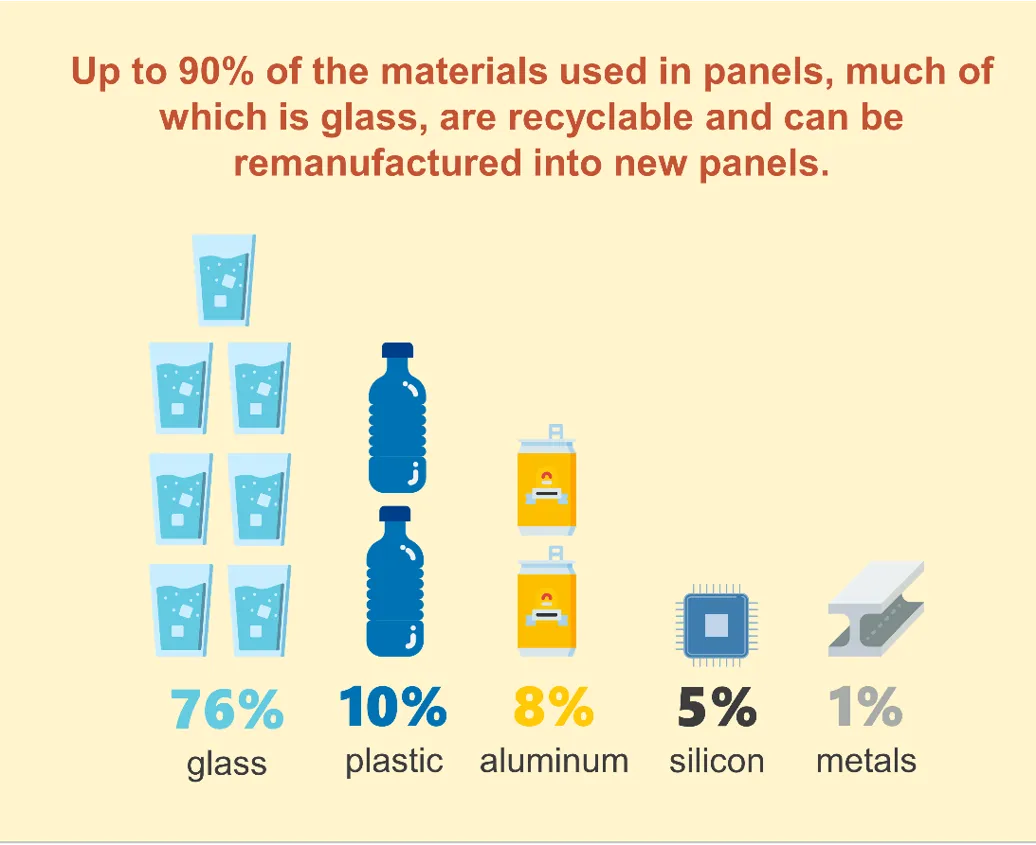
At the end of a solar facility’s useful life, estimated to be between 30 and 50 years, panels can be removed and either reused or recycled. Because solar panels can generate as much as 80% of their initial output after 40 years, a significant and growing secondary market exists for used and refurbished solar panels. Panels that are not suitable to be reused can be recycled.
Recycling programs are designed to recover 90% or more of the materials used in the panels, much of which is glass. In fact, the International Renewable Energy Agency projects that the value of recovered materials could exceed $15 billion by 2050 and that the material recovered could be used to remanufacture two billion solar panels.
Learn more from the American Clean Power Association by reading their fact sheethere.
How will the project impact farmland and local agriculture?
America needs energy, and America needs its farms. As our nation seeks new locations for solar energy facilities, America’s farmers and ranchers are finding new opportunities to diversify their farm operations by adding solar.
Solar farms act as a reliable, drought-resistant “crop” for local farmers. Access to such a consistent revenue stream in the face of uncertain commodity prices, input costs, trade policies, and weather patterns can help farmers stay in business, supporting the preservation of their farms and way of life.
Solar projects can also help prevent urban sprawl and ensure that agricultural land will not be lost to more permanent uses, such as residential development, which poses a far greater threat to farmland than solar energy does in many parts of the country.
Of the nearly 900 million acres of farmland across the United States, the National Renewable Energy Laboratory estimates that solar will occupy fewer than one-half of one percent of those acres by 2030, or about twice the amount of land dedicated to golf courses nationwide.
Learn more about solar and agricultural land use here.
Does solar affect property values?
It is a common misconception that ground-mounted solar panels decrease nearby property values. Multiple studies have found that the value of properties near solar farms increased after the facilities were installed. Appraisal studies spanning multiple states have found that even properties adjoining solar farms match the value (within one percent) of similar properties that do not border solar farms. (Source: American Society of Farm Managers and Rural Appraisers, “Solar’s Impact on Rural Property Values,” February 2021.)
Studies have also found that substantial benefits are flowing to communities where solar farms are located. A report by the University of North Carolina examined the economic impact of more than 100 solar projects in over 50 countries and found that solar facilities have increased the tax revenue from agricultural property by between 1,000% and 10,000%.
What are solar panels made out of?
Apex generally utilizes bifacial monocrystalline silicon solar modules. These panels use a crystal lattice of silicon atoms to convert sunlight into electricity. They are called “bifacial” because they have solar semiconductor materials on both sides of the panel, which allows each panel to generate more electricity than a single-sided panel would. Silicon is the second most-abundant material on Earth (after oxygen) and the most common semiconductor used in computer chips. It is nontoxic.
Apex Clean Energy uses panels that pass the U.S. Environmental Protection Agency’s Toxicity Characteristic Leaching Procedure (TCLP) test, which subjects panels to simulated landfill conditions to ensure that they would not be toxic or leech toxic concentrations of chemicals during operations or if disposed. This testing has found TCLP-compliant panels to be durable, nonhazardous if disposed, and capable of withstanding extreme conditions without leaching.
What about Cadmium Telluride panels?
The other type of solar panel technology used today is called thin-film technology. Apex has not used thin-film panels on any of our solar projects to date.
Thin-film panels use cadmium telluride (CdTe) as the semiconductor material. CdTe is chemically stable, insoluble in water, and it has an extremely high melting point (1,906°F) and boiling point (1,922°F).
Thin-film solar panels are made by painting exceptionally thin layers of CdTe (about 3% of the thickness of a human hair) on glass, and then sandwiching the material under another layer of glass. CdTe is a stable crystalline compound formed from cadmium and tellurium. It behaves very differently than cadmium alone or other cadmium-based compounds. All of these factors make it highly unlikely that cadmium will ever escape the panel. Furthermore, the vapor pressure of CdTe at ambient conditions is zero, so it is impossible for any vapors or dust to be generated when using CdTe PV modules.
Finally, there is simply so little CdTe in thin-film panels that even in modeled worst-case scenarios, the amount of cadmium that could theoretically leach into the soil from a thin-film solar energy facility would be far lower than the nation’s strictest health screening values and 400-6,000 times lower than the amount of cadmium that regularly leaches from common phosphate fertilizers used regularly by American farmers. To date, more than 50 peer reviewed papers from leading institutions around the world have confirmed the safety of CdTe solar technology during normal operation, fires, module breakage, and end-of-life recycling and disposal.
You can learn more about this technology from manufacturer First Solarhttps://www.firstsolar.com/en/Technology/CadTel>here.
(Source 1: V. Fthenakis and K. Zweibel, “CdTe PV: Real and Perceived EHS Risks,” National Renewable Energy Lab (May 2003))
(Source 2: Sinha, Parikhit et al. “Fate and transport evaluation of potential leaching risks from cadmium telluride photovoltaics.” Environmental toxicology and chemistry vol. 31, 7 (2012), pp. 1670-5)
Can solar panels withstand hail and other types of severe weather?
Solar panels are durable and are expected to function effectively for up to 40 years. This is largely because they have no moving parts and are designed to withstand rain, snow, hail, high winds, and other harsh conditions. A study by the National Renewable Energy Laboratory of over 50,000 solar energy systems found that they are extremely dependable, with less than 0.1% per year underperforming or showing defects.
Most modern solar panels must obtain a test certificate under the IEC 61215 Standard. During the test, the solar panels are struck with 11 ice pellets, each 1 inch in diameter, at a velocity of 50 miles per hour (tropical storm force winds). To meet the standard, the solar panel needs to show no visual defects (no cracks or chips in the tempered glass that sits above the solar cells) after the test. Tier 1 solar modules and tracking systems are rated for wind speeds ranging from 110-140mph.
In addition to the hail test, international testing standards evaluate panels for their ability to withstand freeze/thaw cycles, high humidity conditions, rain and water infiltration, mechanical load tolerance (simulation of wind/snow load), corrosion, and other potential stressors.
Are solar panels a fire risk?
Fires caused by solar equipment are rare and only occur if an improper connection or other electrical fire hazard is present. Good system design, product selection, and proper installation procedures further minimize the low risk of fire at a ground-mounted solar facility.
These concerns are also addressed by product safety standards, National Electrical Code provisions, and inspections that take place prior to solar facility energization. In addition, Apex Clean Energy consults with local first responders to ensure they have the training, facility information, and equipment needed to respond in the unlikely event of an incident within the facility.
Another factor that limits solar panel fires is their composition. The vast majority of each solar panel is composed of nonflammable material—primarily, one or two layers of protective glass that make up over three-quarters of the panel’s weight, as well as an aluminum frame.
Are solar panels safe?
Yes, solar panels are safe and solar energy has not been linked to any adverse human health issues. Over 4 million American households now have residential solar systems attached to or adjacent to their homes as of 2024.
Solar energy has proven beneficial to public health by displacing air pollution and conserving clean water. In fact, the health benefits created by the 20 GW of solar power that was installed in the United States through 2014 saved Americans about $890 million per year. The amount of installed U.S. solar capacity has increased sevenfold since then.
The Clean Energy Technology Center at North Carolina State University conducted an exhaustive analysis of health and safety questions surrounding utility-scale solar energy projects, including concerns regarding toxicity, electromagnetic fields, fire safety, and electric shock potential. For each of these topics, they concluded that “the negative health and safety impacts of utility-scale PV development were shown to be negligible, while the public health and safety benefits of installing these facilities are significant and far outweigh any negative impacts.”
Source:https://content.ces.ncsu.edu/health-and-safety-impacts-of-solar-photovoltaics
Are solar panels noisy?
Solar panels themselves are completely silent. Certain pieces of equipment on a solar farm do emit sound. Transportation and maintenance equipment—including cars, trucks, lawnmowers, and string trimmers—is a common source of noise on solar farms that most people are used to hearing elsewhere.
In addition to these sources, inverters and transformers on a solar farm will generate low levels of sound during the day when the sun is shining. The impact of this sound is negligible because the equipment is strategically placed in the center of properties hundreds of feet from residences to allow the sound to naturally dissipate.
Do solar panels produce glare?
Solar panels are designed to absorb sunlight and minimize reflection, as any light reflected by the panels cannot be converted into electricity. Modern PV panels reflect as little as 2% of the light that strikes them, a value that is lower than that of grass, water, crops, or snow.
According to the FAA’s 2018 Airport Solar Guide, solar photovoltaic systems are “designed to absorb sunlight (rather than reflect it), minimizing potential impacts of glare.” Since 2010, more than 20% of U.S. airports have adopted on-site solar power, providing further evidence that solar panels do not produce significant glare.
What happens if the solar farm goes out of use?
Although large-scale solar energy is relatively new, solar cell technology is not. The first commercially viable solar cell was unveiled in 1954. More recently, long-term studies of modern solar panels indicate that they perform well over time, with an average degradation rate of approximately 0.5% per year. Typically, manufacturer warranties guarantee that solar panels will generate at least 90% of their original capacity after 20 years and 80% after 40 years.
There are often concerns about what happens to a solar farm once it stops producing energy or if the owner goes out of business. As part of the permitting process, Apex must provide a complete detailed decommissioning plan that is funded by an irrevocable form of financial security to cover decommissioning costs. This ensures that money is always available to remove the solar farm if or when it is no longer operable.
Will solar projects harm local wildlife?
Utility-scale solar projects can be designed to have very limited impact on the underlying land. Once installed, about half of the land within the solar project remains open space. This open area between panels will be seeded with noninvasive groundcover that may include pollinators, grazing grasses, or other native plants. Trees and shrubs may also be planted in accordance with local requirements.
Studies show that solar energy facilities can improve biodiversity and benefit wildlife by improving habitat in their immediate vicinity, especially on previously disturbed land. With proper planning, solar farms can improve the environment and enhance local ecological services by naturalizing areas around solar facilities, improving wildlife habitat and water cycling, increasing pollination and erosion control, and even helping threatened species. Solar farms can also help create new habitat, providing pollinator-friendly ecosystems and high-quality hunting and foraging habitat for birds.
Although solar panels may modify wildlife habitat in the facility’s immediate footprint, evidence suggests that these changes can be balanced by other habitat-based benefits. Depending on site-specific conditions, solar panel areas may also incorporate specific wildlife corridors in the project's design.